Geothermal Energy Westland

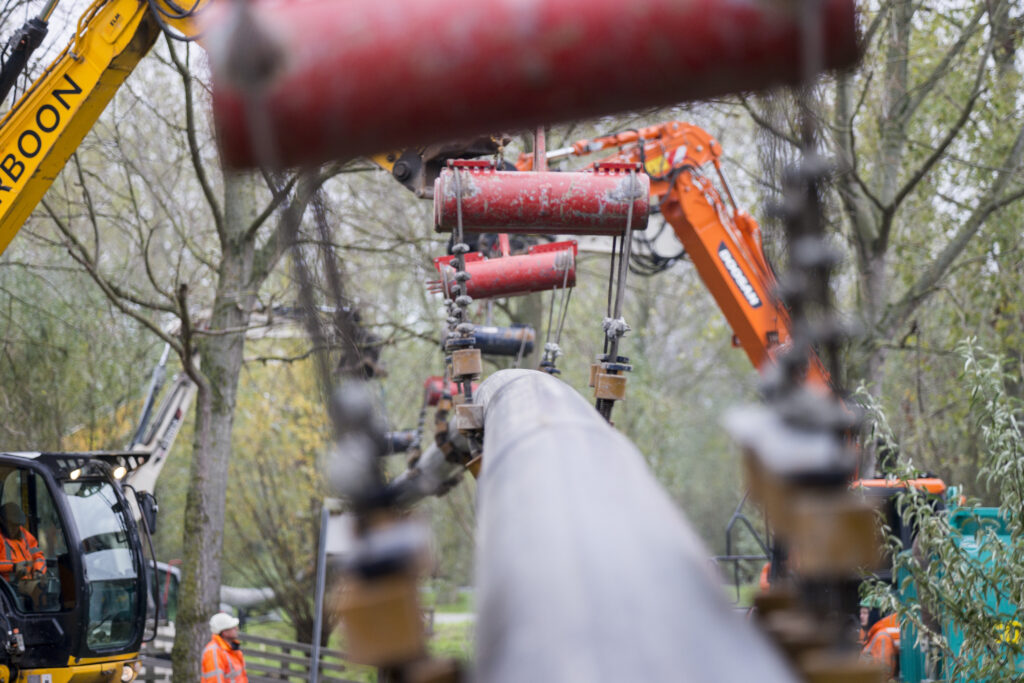
The Trias Westland partnership will use geothermal energy as a natural source for a heat network in the Westland region. As a result, the greenhouse horticulture industry, a major energy consumer, is undergoing a massive sustainability transformation. A.Hak is installing the pipelines.

Trias Westland aims to make greenhouse horticulture in the Westland region much more sustainable. By switching from natural gas to geothermal energy for heating, a significant reduction in CO2 emissions can be achieved. Deep in the earth, there are water-bearing layers with naturally warm water. In the Netherlands, when you go underground, the temperature increases by about 30 degrees Celsius per kilometer of depth. This warm water can be used as an energy source for a heat network.

Four kilometers deep
Trias Westland wanted to investigate whether the Triassic layer, at a depth of about four kilometers, was a suitable earth layer for profitable water extraction. A test drilling carried out at this spectacular depth provided a lot of information about the soil composition in the Westland region, but also showed that this layer was not suitable for the profitable extraction of warm water for a heat network. At a somewhat shallower depth, but still 2.7 kilometers below the earth’s surface, excellent conditions for hot water extraction were found in the Lower Cretaceous layer.

The name Trias Westland had already been established and thus remained, despite the fact that the Triassic layer no longer plays a significant role in the project. The Lower Cretaceous layer, more specifically the Delft sandstone, certainly does play that role. The heat yield from this layer seems likely to exceed earlier expectations. When the first part of the heat network is completed in the second half of 2019, 49 growers will use the heat from this earth layer.

Busy underground
The specialists from A.Hak came into the picture for the construction of this heat network. They encountered a tough challenge in the Westland region. Anyone who knows the area a little knows that it’s quite crowded. Houses, commercial buildings, and of course the endless greenhouses stand along narrow roads and many ditches. Underground is also busy, with a lot of infrastructure already under the roads and verges. ‘It’s quite a challenge to determine the routing for a completely new heat network here,’ says project manager Ronnie Kerdijk from A.Hak. ‘And then to install it without problems between the existing cables and pipes.’

‘18.5 megawatts of energy is being extracted from the ground here,’ Kerdijk continues, ‘with hot water coming from 2,700 meters deep. From the source, the water is led to a heat exchanger station that regulates the pressure and temperature and also filters the water. After that, it is pumped into the thirteen-kilometer-long pipeline system.’

Working in a construction team
For the construction of the heat network, collaboration in a construction team was chosen. In a traditional relationship between client and contractor, the work is tendered after the client has made a design or had it made by an engineering company. The contractor who is awarded the work then realizes that design. In this project, it’s a real challenge in many places to fit the pipeline into the maze of existing underground infrastructure. Once the best location is found, the right execution technique must be chosen. Sometimes digging is better, and in other cases, drilling is chosen.

The construction team, consisting of client Trias Westland, Rotterdam Engineering, A.Hak, Welvreugd, and pipe supplier Logstor, tackles these challenges one by one throughout the project. In this way, the creativity and knowledge of all involved are optimally utilized, and no design decisions are made in advance that prove to be unfeasible during execution.

Tight schedule
‘By working together in a construction team, we jointly arrive at the best design and the most suitable execution method. It’s a very different way of working that works really well when all parties collaborate intensively.’ And that was certainly the case with this project. ‘Engineering and construction were almost running in parallel. Sometimes others were still busy applying for permits or negotiating with landowners while the execution of the work was about to begin.’ So far, this has led to a project that has been carried out according to a tight schedule, a cost saving of about thirty percent, and a proud project manager.

Other projects