

Wijk aan Zee
First: fully electric drilling
A drinking water transport pipeline through the dunes
Together with client PWN, A.Hak experienced what is involved in a fully electrically controlled drilling. And if it were up to Nick Verboven, this experience leaves a taste for more. “Next time, we will definitely show interest and sign up.”
A first for A.Hak and client PWN. At the end of October, they completed a fully electric controlled drilling for a drinking water transport pipeline through the dunes at Wijk aan Zee. The pipeline, with a length of 1 kilometer, connects the PWN production site Jan Lagrand in Heemskerk with the drinking water production site Wim Mensink in Wijk aan Zee. Among other reasons, due to the protected dune area, the drilling had to be emission-free. “Fortunately, we had plenty of preparation time,” Nick Verboven reflects. “Because it was quite a challenge to arrange all the necessary electric equipment.”
In its infancy
Nick is a calculator, but mainly a ‘jack of all trades’ at A.Hak. He has been involved in the project since the tender phase. “Of course, before making an offer, you make agreements with subcontractors and companies, but in this case, we had to deviate somewhat from what we had initially planned. You notice that electrification in the sector is still in its infancy or that electric equipment is mainly used on long-term projects.”
Fortunately, thanks to sustainability coordinator Caglar Yilmaz, A.Hak has good connections in the market. For example, Van Werven was engaged for the electric crawler crane and Van der Vlist for electric transport. Gebr. van ‘t Hek Foundation Techniques ensured the emission-free installation of the dead bed, and A.Hak Drillcon provided the electric 150-tonner, including equipment. “Actually, I could list a whole laundry list of companies that supported us,” Verboven says with a laugh. “And ultimately, we gained many new, good contacts from this project.”
GenPower
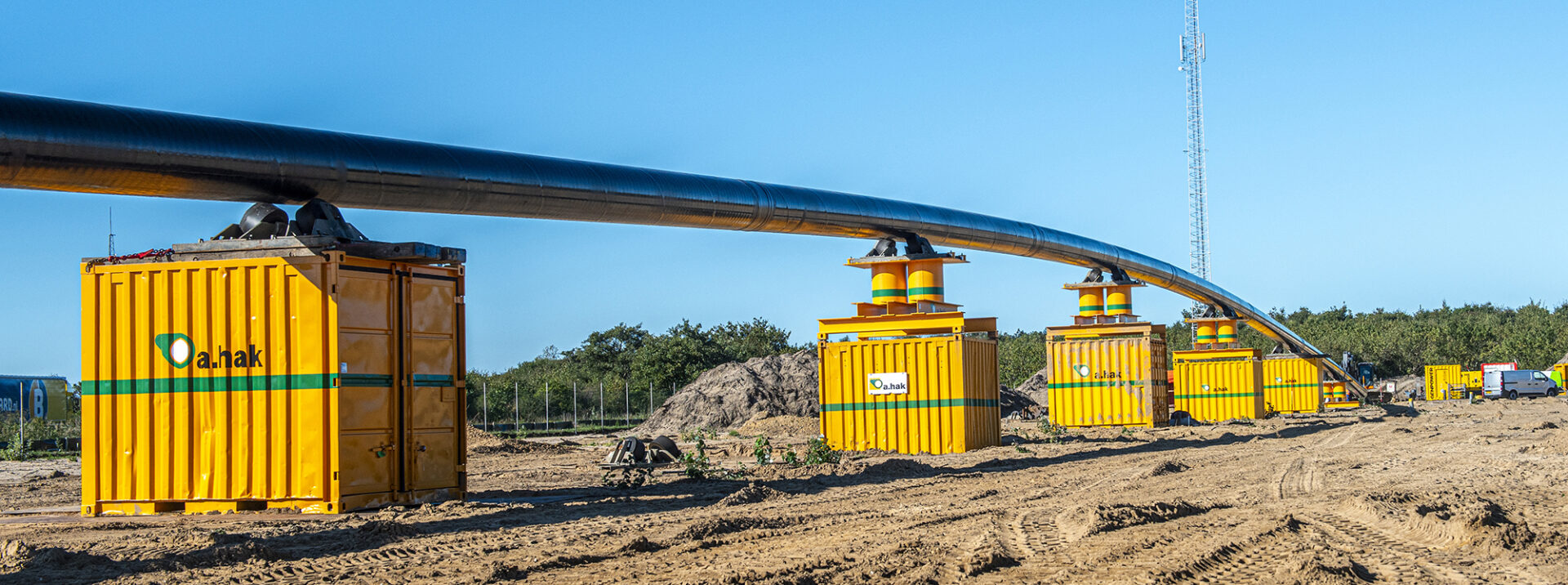
With the project in Wijk aan Zee, A.Hak also laid a solid foundation for future projects with GenPower. GenPower played a crucial role in the success of the fully electric drilling. GenPower not only supplied the transformers that kept the voltage stable but also installed advanced battery storage systems to handle peak loads and ensure the emission-free operation. Thanks to GenPower’s expertise, all necessary equipment was continuously powered without any interruption.
“Without GenPower’s efforts, we could not have executed this operation so smoothly,” Verboven emphasizes. “They completely relieved us in terms of energy supply, allowing us to focus entirely on the technical execution of the drilling.”
Clear agreements
With so many parties involved, a good end result depends on making clear agreements in advance. “To reach the entry point, Van ‘t Hek had to pass through a residential area with the electric wire crane for installing the dead bed. You plan traffic arrangements, but you also make firm agreements with Van ‘t Hek that they will be available with their transport at that time. The same goes for Van der Vlist.”
Limited availability
PWN was understanding throughout the project. The drinking water company also saw that electric equipment is limited in availability and that companies are hesitant to purchase it. According to Verboven, it would be good for A.Hak to sign contracts with providers of electric equipment in the run-up to the next electric drilling. Because as far as he is concerned, that next electric drilling is definitely coming. “Now that we have tasted fully electric drilling with this pilot in Wijk aan Zee, we will certainly show our interest and sign up for the next project. We now have better insight into what electric equipment can handle. All in all, this project has gone well in every respect.”